
Last Updated on 1 month ago by Saleha Asad
Stop Overpaying: The Complete Cloud Cost Optimization Playbook
Contents
- 1 Stop Overpaying: The Complete Cloud Cost Optimization Playbook
- 1.1 Table of Contents
- 1.2 Why Cloud Cost Optimization Is Important in 2026
- 1.3 Cloud Optimization Planning: The Right Way to Start
- 1.4 Cloud Cost Optimization Best Practices That Actually Work
- 1.5 Cloud Cost Optimization Strategies for Small Businesses
- 1.6 5. The Best Tools for Cloud Cost Optimization
- 1.7 6. Cloud Cost Optimization Comparison Table
- 1.8 FAQs : (People Also Ask)
- 1.9 What is cloud cost optimization?
- 1.10 Why is cloud cost optimization important?
- 1.11 What is the first step in cloud optimization planning?
- 1.12 What cloud cost optimization strategies work best for small businesses?
- 1.13 What are the most important cloud cost optimization best practices?
- 1.14 How much can cloud cost optimization actually save?
- 1.15 What tools work best for cloud cost optimization?
- 1.16 Conclusion
- 1.17
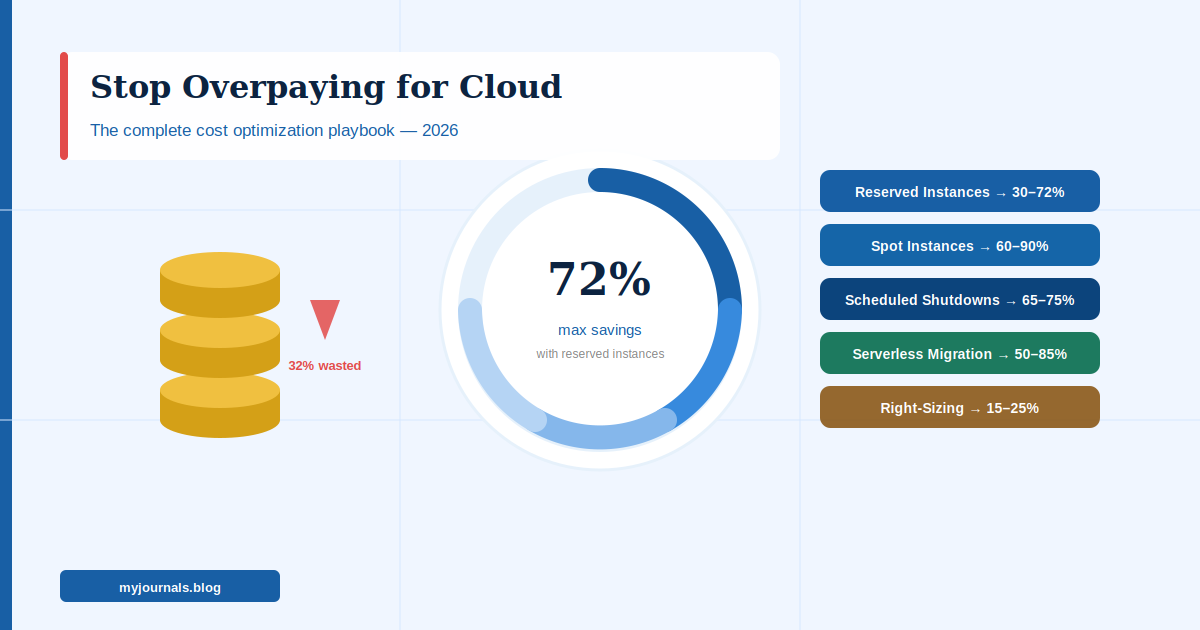
Cloud cost optimization is one of the most pressing challenges for organizations in 2026 but it’s just one part of a complete cloud computing strategy. According to Flexera 2024, State of the Cloud Report, US organizations waste an average of 32% of their total cloud budget every single year. Not because the cloud is broken. Because nobody is doing cloud cost optimization and watching the bill closely enough.
Cloud cost optimization is the process of defining, removing, and avoiding wasted cloud spend. Its goal is to ensure every dollar invested in cloud infrastructure delivers quantifiable business value. It is not regarding spending less. It is regarding spending right.
This is not the same conversation as your cloud computing strategy at large. This guide goes one level deeper, directly into the dollars. In this guide you will learn why cloud cost optimization is important for US businesses right now, how to build a cloud optimization plan that actually sticks, the cloud cost optimization best practices proven to deliver 20 to 35% savings, and targeted cloud cost optimization strategies for small businesses working with lean budgets and smaller teams.
Every section is practical, specific, and built for action.
Table of Contents
- Why Cloud Cost Optimization Is Important in 2026
- Cloud Optimization Planning: The Right Way to Start
- Cloud Cost Optimization Best Practices That Actually Work
- Cloud Cost Optimization Strategies for Small Businesses
- The Best Tools for Cloud Cost Optimization
- Cloud Cost Optimization Comparison Table
- FAQ: People Also Ask
- Conclusion
Why Cloud Cost Optimization Is Important in 2026
Cloud cost optimization is important because unmanaged cloud spending drains profit without delivering any additional performance, reliability, or competitive advantage. Most US businesses discover their waste only after months of compounding charges they cannot fully explain.
The scale of the problem is bigger than most teams realize.
The Waste Is Not Small and It Is Not Slowing Down
According to the Flexera 2024 report that surveyed more than 750 cloud decision makers around the globe, cloud cost optimization was the number one cloud priority in the third consecutive year. 82% of respondents rated it as one of the greatest challenges. Nonetheless, the average organization remains only 68% resource utilization, or one-third of all that is provided is idle.
For a US business spending $500,000 per year on cloud, 32% waste equals $160,000 that produces nothing. For a $2 million per year cloud environment, that is $640,000 disappearing annually into oversized servers, forgotten storage volumes, and services nobody uses anymore.
According to the 2024 FinOps Foundation State of FinOps Report, US companies with structured cloud cost optimization programs reduced waste by an average of 28% in their first year. Companies without any program saw costs grow by an average of 23% year over year. This happened regardless of whether actual usage grew proportionally.
What Unmanaged Cloud Spend Does to a Business
The financial damage is obvious. The operational damage is less discussed but equally serious.
Three organizational issues arise simultaneously when cloud spending is not accountable. Engineering and finance cease to talk the same language. Engineers see the cloud as infinite infrastructure. Finance perceives it as an unwieldy cost. That strain slows down the procurement process, projects, and internal tension, which has nothing to do with technology and everything to do with lacking governance.
Second, technical debt accumulates invisibly. Overprovisioned resources become the default because nobody penalizes engineers for provisioning too much. Over time, this creates an environment where every future workload gets sized for imagined peak demand rather than actual expected load. The result is waste baked into every new deployment before it even launches.
Third, there is no longer the ability to negotiate power with cloud vendors. Enterprise discount programs, private pricing agreements and committed use contracts are available in AWS, Azure, and Google Cloud. Companies that do not have access to their own expenditures are unable to bargain with any degree of knowledge. They are default list takers and will pay the charge the provider charges most.
Cloud cost optimization is important not just because it saves money today. It builds the financial discipline and visibility that compounds into competitive advantage over the next three to five years.
Cloud Optimization Planning: The Right Way to Start
Cloud optimization planning is the structured process of auditing your current environment, assigning ownership to every resource and cost, and building a prioritized roadmap before changing anything. Skipping planning and jumping straight to action is the single most common reason cloud cost optimization efforts produce one-time cuts that reverse within six months.
Most competitors do not do this. They inform you on what to maximize. They do not explain to you how you should establish the conditions that will ensure that the optimization is sustainable.
Run a Complete Inventory Before Touching Anything
You cannot optimize resources you cannot see. The first step in any serious cloud optimization planning effort is pulling a full inventory of every active resource across every account, every region, and every environment.
This encompasses compute instances, managed databases, storage buckets and volumes, load balancers, elastic IP addresses, NAT gateways, data transfer configurations, and all third-party integrations billed to your cloud account. Most organizations discover in this step that 15–20% of their inventory is either totally unused or totally abandoned. That inventory belongs to projects or teams that no longer exist.
AWS Cost Explorer, Azure Cost Management, and Google Cloud Asset Inventory all provide this visibility at no cost. Use them before making a single change.
Tag Everything or Optimization Will Fail
Tagging is the foundation of cloud optimization planning that produces sustained results. Every resource should carry at least four tags: the owning team, the project it serves, the environment it runs in (production, staging, or development), and the responsible cost center.
Without tags, you cannot answer the most important question in cloud financial management: who is spending what and why? The 2024 FinOps Foundation report found that organizations with consistent tagging practices reduced unattributed cloud spend by an average of 40% within 90 days of implementation.
Set a tagging policy before your next sprint.Use AWS Service Control Policies or Azure Policy to automate tag enforcement. This prevents engineers from creating new resources without required tags. This eliminates the root cause of invisible spending at the source.
Set Budget Alerts Before Costs Surprise You
Set a monthly budget maximum for each account, team, and each project. Configure an alert at 80% of that maximum. This capability is free with AWS Budgets, Azure Cost Alerts, and Google Cloud Budget Alerts.
This one practice eliminates end-of-month bill shock. Bill shock is the most common trigger for reactive and poorly planned cost cutting. When teams see their spending in real time, behavior changes without requiring top down mandates.
Build a Three Horizon Optimization Roadmap
When you have achieved inventory visibility, tagging/ownership, and alerting, then organized your optimization efforts according to three time horizons
This 30-day horizon aims for quick wins like switching off unused resources, deleting orphaned storage, and removing duplicate services-requiring zero architectural modifications while reclaiming 10-15% of wasted spend instantly.
The second horizon is a 60-90 day period during which the focus will be on right-sizing, buying reserved capacity, and storage life cycle. These tasks involve minimal engineering but involve some analysis, and should result in an additional 15-20% of spending reduction.
The third horizon covers 90 days to 12 months and addresses architectural improvements like auto scaling, spot instance adoption, serverless migration for eligible workloads, and cloud cost optimization governance structures that prevent future waste from accumulating.
Cloud Cost Optimization Best Practices That Actually Work
Cloud cost optimization best practices are the repeatable technical and financial habits that keep cloud spending aligned with actual business value on a continuous basis, not just in a one time cleanup. The difference between organizations that sustain those savings and those that watch costs creep back up is whether they treat these as permanent disciplines. According to the Gartner 2023 Cloud Cost Management report, structured programs deliver 20 to 35% savings in year one when maintained consistently.
Right Size Every Instance on a Quarterly Schedule
Right-sizing means matching the size and type of compute instance to what your workload actually requires, as opposed to what someone thought it would require when they initially deployed it. Typically, people overestimate by 40-60% when first moving workloads to cloud; it feels less risky to over provision than under provision.
How to fix it: Analyze each instance whose monthly expenditure is over $100. Average its CPU usage and memory usage over the last 30 days. If the usage average of either resource is less than 40%, scale it down to the next smaller instance tier. The AWS Compute Optimizer, the Azure Advisor, and the Google Cloud Active Assist automate these investigations and produce customized recommendations for free.
According to a 2023 McKinsey study of US enterprises, right sizing alone delivered an average 18% reduction in monthly compute costs within 90 days when executed with a quarterly review cadence. One time right sizing delivers diminishing returns. Quarterly review delivers compounding savings. You can explore how AWS structures this practice inside the AWS Cost Optimization Pillar whitepaper.
Commit Reserved Capacity to Predictable Workloads
Why On-Demand Pricing Costs More
On-demand pricing carries by far the highest cost for operating steady and predictable workloads. AWS Reserved Instances, Azure Reserved VM Instances, and Google Cloud Committed Use Discounts can save 30-72% versus the cost of on-demand pricing with a commitment between 1 to 3 years.
This ranks among the highest-impact cloud cost optimization best practices available to any organization running workloads with consistent demand. A team paying $15,000 per month for on demand compute on workloads running at stable capacity can realistically reduce that to $8,000 to $10,000 per month by converting to reserved capacity.
How to Commit Reserved Capacity Without Introducing Waste
The critical practice: Do not bind reserved capacity to workloads that teams do not consistently use above 70%. Binding capacity that sits underused only introduces a different type of waste.
Auto Scaling and Spot Instances
If you do not use auto scaling, you pay for peak capacity 24/7 regardless of actual need. Every Tuesday in February, they pay for Black Friday server capacity. With proper auto scaling, they pay for small capacity right up until the actual peak arrives, then scale back immediately once traffic drops paying only for actual use.
However, the trade-off is that the provider can terminate your computing instance(s) with little or no notice whenever it requires the resource.
However, it fits batch processing, CI/CD pipeline runners, ML model training, overnight ETL jobs, and any task that can fail and restart from a checkpoint.
This ranks among the fastest available cloud cost optimization best practices and carries virtually zero engineering risk.
Strategies for Small Businesses
These strategies are built for that reality.
Mapping every new workload against free tier availability before provisioning paid resources is one of the most impactful cloud cost optimization strategies for small businesses it costs nothing to implement and requires only awareness to execute.
One of the clearest cloud cost optimization strategies for small businesses is to buy managed services and redeploy your engineers toward product.
For small companies with unpredictable traffic, this is the highest-leverage cost optimization technique that cloud has to offer.
Governance and Long-Term Discipline
CloudHealth by VMware focuses on governance and policy for multi-cloud.
If your organization has not yet defined its overarching approach to cloud including governance, migration planning, hybrid cloud decisions, and security frameworks the savings you generate through cost optimization will remain limited and temporary.
What is cloud cost optimization?
Why does cloud cost optimization matter?
Without knowing what you have and what it costs, no optimization action can be reliably targeted.
What cloud cost optimization strategies work best for small businesses?
What tools work best for cloud cost optimization?
Native tools are sufficient, free, and most cost-effective for cloud spend up to $50k per month (AWS Cost Explorer, Azure Cost Management, Google Cloud Cost Management), while multi-cloud teams spending $50k+ need the unified visibility and governance that AWS Cost Explorer alone cannot deliver making CloudHealth by VMware and Apptio Cloudability the right fit at that level.
It is a financial discipline that compounds over time when organizations build it into how they operate every day not just when the bill gets too high to ignore. Look at 60 days or more of historical usage before committing to buying capacity.
Implement Auto Scaling on Every Variable Workload
Auto scaling scales compute resources up and down based on the level of incoming traffic. If auto scaling is not used you would pay for peak capacity 24/7 regardless of the actual need for the capacity.
Imagine that a U.S.-based retail business needs an infrastructure of a certain capacity that will remain fixed for the holiday shopping rush. On every Tuesday in February they are being charged for the server capacity on Black Friday. If auto scaling is used properly, they will be charged for a small capacity up until the actual peak arrives and then scale back immediately once traffic is no longer high-only paying for actual use.
Each of the leading cloud vendors provides native auto scaling at zero additional cost. We see it in AWS Auto Scaling Groups, Azure Virtual Machine Scale Sets, and Google Cloud Managed Instance Groups. The only thing that would stop a business from using it is the overhead to implement-usually, a single sprint of engineering work that saves compounding cost benefit for years.
Use Spot and Preemptible Instances Strategically
By using AWS Spot Instances, Google Cloud Preemptible VMs, and Azure Spot VMs, you are essentially acquiring computer instances and a price from 60-90% cheaper than their on-demand price. However the trade-off is that your computing instance(s) can be terminated with little or no notice as the provider requires the resource.
As such, it’s not a suitable choice for a production database, or customer facing web servers. However it’s a good fit for batch processing, CI/CD pipeline runners, ML model training, overnight ETL jobs and indeed any task which is prepared to fail and restart from a checkpoint.
One US-based software company had previously had a nightly data-processing pipeline running on demand resources. Within the span of one afternoon it changed the pipeline to run on spot resources, resulting in annual savings of $87,000 while not having to change a single line of the application.
Apply Storage Lifecycle Policies Immediately
Storage waste, while quieter than compute waste, tends to be much larger in total volume. Old log files and expired backups, development data sets, orphaned build artifacts-it all piles up on S3 buckets, Azure Blob containers, and Google Cloud Storage buckets without an automated action or life cycle rule.
AWS S3 Intelligent Tiering automatically moves infrequently accessed data to lower cost storage tiers with no performance penalty for retrieval. Azure Lifecycle Management and Google Cloud Object Lifecycle Management offer equivalent functionality.
A report released in 2024 by the FinOps Foundation showed that U.S. Organizations that deployed storage lifecycle policies achieved an average of 35% object storage cost savings in 60 days from deployment. This is one of the fastest available cloud cost optimization best practices that carries virtually zero engineering risk
Cloud Cost Optimization Strategies for Small Businesses
Cloud cost optimization strategies for small businesses prioritize speed, simplicity, and high return actions that do not require dedicated FinOps teams, complex tooling, or large engineering resources to execute. Small US businesses waste proportionally more than enterprises. The 2024 SMB Group study found that US small businesses waste an average of 38% of their cloud budget, six percentage points higher than the enterprise average.
The reason is not carelessness. It is that small teams never had the bandwidth to establish the governance structures that large organizations eventually build. These strategies are designed for that reality.
Start With Free Tier Architecture and Stay There as Long as Possible
Free Tier available from AWS, Google Cloud and Azure. Both offer excellent free tier packages, the vast majority of early-stage small businesses won’t even use it up.AWS includes Free Tier with 750 hours per month t2.micro compute, 5GB of S3, 1M Lambda requests, 25GB of DynamoDB, for free.Google Cloud includes $300 credit for first 6 months as well as having certain services for free forever.
Mapping every new workload against free tier availability before provisioning paid resources is one of the most impactful cloud cost optimization strategies for small businesses because it costs nothing to implement and requires only awareness to execute.
Choose Managed Services Over Self Managed Infrastructure
On a small team the TCO of managed service typically wins, if you are honest about your engineering costs. EC2 costs less per computer hour than RDS, but once you factor in the 10-20 engineering hours per month necessary to handle backups, patching, performance tuning, and failover on your own, managed is cheaper by a landslide.
A small US SaaS company paying $350 per month for RDS Multi AZ avoids an estimated $2,500 to $4,000 per month in engineering labor that would otherwise go into database operations. This is one of the clearest cloud cost optimization strategies for small businesses: buy managed services and redeploy your engineers toward product.
Go Serverless for Unpredictable and Intermittent Workloads
Serverless computing through AWS Lambda, Google Cloud Functions, and Azure Functions charges only for the milliseconds of execution time consumed. There are no idle servers. There is no minimum capacity payment. If your application receives no traffic for six hours, you pay nothing for those six hours.
For small companies with unpredictable traffic, it’s the highest leverage cost optimization technique that cloud has to offer. A small SaaS company that moved its backend API off always on EC2 instances to AWS Lambda only cut down their monthly compute spend from $1200 to $140. It processed exactly the same amount of requests as shown in an AWS case study released in 2023.
Schedule Non Production Environments to Shut Down Automatically
Development, staging, and QA environments do not need to run at 3am on a Saturday. Most do anyway, because nobody ever configured them to stop.
You can set up start and stop schedules for non production resources in AWS Instance Scheduler, Azure Automation and Google Cloud Scheduler. Turning off development environments when no one is using them ( usually for 18 hours during the weekdays and on the weekend) cut the compute costs of those environments by 65-75% and didn’t affect the developer productivity in any way.
For a small business running $2,000 per month in development infrastructure, this single configuration change saves $1,300 to $1,500 per month. It takes less than two hours to set up.
5. The Best Tools for Cloud Cost Optimization
The right cloud cost optimization tools provide real time visibility into spending, automated waste detection, and governance controls that prevent overspending before it happens rather than reporting it after.
Native Cloud Tools: Free and Sufficient for Most Teams Under $50K Per Month
Every major cloud provider includes a built in cost management suite at no additional charge.
AWS Cost Explorer provides interactive cost and usage graphs with filtering by service, region, account, and tag. Its Budgets sets spending thresholds with automated alerts. AWS Compute Optimizer analyzes workload utilization and recommends right sizing. For teams running primarily on AWS, these three tools together cover the vast majority of cloud cost optimization needs without any additional spend.
Azure Cost Management and Billing and Google Cloud Cost Management offer equivalent capabilities on their respective platforms.
Third Party FinOps Platforms: For Multi Cloud and Higher Spend Environments
Third party platforms are able to perform functions that native tools are not able to do for organizations expending more than $50,000 a month and or managing workloads spread over multiple vendors.
Apptio Cloudability handles cost allocation, showback and forecast for AWS, Azure and Google Cloud. Cloud Health by VMware focuses on governance and policy for multi-cloud. Spot.io by NetApp provides automation of spot instances management for 60-80% compute cost savings for relevant workloads.
These platforms typically cost 1 to 3% of the cloud spend they manage and return average savings of 20 to 40% in year one, producing a straightforward return on investment for most US enterprises.
6. Cloud Cost Optimization Comparison Table
| Strategy | Savings | Effort | Results In |
|---|---|---|---|
| Right-sizing instances | 15–25% | Low | 30–60 days |
| Reserved instances | 30–72% | Low | Immediate |
| Auto scaling | 20–40% | Medium | 60–90 days |
| Spot instances | 60–90% | Medium | 30 days |
| Storage lifecycle | 25–35% | Low | 30–60 days |
| Serverless migration | 50–85% | High | 90–180 days |
| Scheduled shutdowns | 65–75% | Very Low | Under 1 week |
How This Fits Into Your Broader Cloud Computing Strategy
Cloud cost optimization does not exist in isolation. It is one of the most critical cluster topics that sits inside a complete cloud computing strategy. If your organization has not yet defined its overarching approach to cloud including governance, migration planning, hybrid cloud decisions, and security frameworks the savings you generate through cost optimization will remain limited and temporary. A fully developed cloud computing strategy gives your optimization work a structural foundation that turns one time savings into permanent financial discipline. For the complete framework covering every dimension of cloud strategy from migration to governance to security, read our full guide: Cloud Computing Strategies 2026: The Only Guide You Will Ever Need.
FAQs : (People Also Ask)
What is cloud cost optimization?
Cloud cost optimization is the ongoing practice of reducing wasted cloud spending by right sizing resources, eliminating idle infrastructure, applying pricing discounts, and building governance processes that align every cloud dollar with measurable business output. It applies to organizations of every size and every cloud provider.
Why is cloud cost optimization important?
It is important because the average US organization wastes 32% of its cloud budget annually, according to Flexera 2024. That waste compounds year over year. Cloud cost optimization recovers that spend, improves profitability, and reallocates budget toward growth rather than inefficiency.
What is the first step in cloud optimization planning?
The first step in cloud optimization planning is a complete inventory audit of every active cloud resource across all accounts and regions. Without knowing what you have and what it costs, no optimization action is reliably targeted. Most organizations discover 15 to 20% idle resources during this step alone.
What cloud cost optimization strategies work best for small businesses?
The highest impact cloud cost optimization strategies for small businesses are using free tier architecture as long as possible, choosing managed services over self managed infrastructure, adopting serverless for variable workloads, and scheduling non production environments to shut down automatically outside working hours. These four actions require minimal engineering effort and deliver results within weeks.
What are the most important cloud cost optimization best practices?
The most important cloud cost optimization best practices are right sizing computers on a quarterly schedule, purchasing reserved capacity for stable workloads, enabling auto scaling on variable workloads, using spot instances for batch jobs, and applying storage lifecycle policies to automate data tiering. Each of these delivers compounding savings when maintained consistently.
How much can cloud cost optimization actually save?
Organizations implementing structured cloud cost optimization programs save an average of 20 to 35% in year one, according to Gartner's 2023 Cloud Cost Management report. Teams that adopt FinOps disciplines and sustain them over three or more years consistently achieve 30 to 40% lower cloud costs relative to unmanaged environments at equivalent scale.
What tools work best for cloud cost optimization?
Native tools are sufficient, free, and most cost-effective for cloud spend up to $50k per month (AWS Cost Explorer, Azure Cost Management, Google Cloud Cost Management), while multi-cloud teams spending $50k+ need the unified visibility and governance that AWS Cost Explorer alone cannot deliver making Cloud Health by VMware and Apptio Cloudability the right fit at that level.
Conclusion
Cloud cost optimization is not a technical project. It is a financial discipline that compounds over time when organizations build it into how they operate every day not just when the bill gets too high to ignore.
Three things to take away from this guide. First, the waste is real and measurable: 32% of the average US cloud budget produces nothing. At a global infrastructure spend of roughly $675B in 2025, 27–32% waste translates to well over $100B in unnecessary cloud spending annually. That number is recoverable with the practices in this guide.
Second, cloud optimization planning done upfront, specifically the inventory audit, tagging, and alerting, is what separates sustained savings from temporary ones. Third, cloud cost optimization strategies for small businesses do not require enterprise tools or dedicated FinOps teams. They require consistency, ownership, and the discipline to act on what your cost data is already telling you.
Start with your inventory audit this week. Tag what you find. Set budget alerts. Then work through the optimization roadmap one horizon at a time. The savings are already sitting in your environment. You just have to claim them.
