Last Updated on 4 days ago by Saleha Asad
Introduction
Contents
- 1 Introduction
- 2 What is the definition of a quick and easy breakfast?
- 3 Why the benefits of eating breakfast are bigger than you think
- 4 The Protein Fiber Speed framework: how to build any breakfast in 5 minutes
- 5 25 best breakfast recipes: ranked by speed, protein, and desk-friendliness
- 6 Healthy breakfast ideas with Greek yogurt: the complete section
- 7 Quick and easy breakfast ideas at work: the desk-friendly playbook
- 8 The science of energy-boosting breakfast foods (including Talbina)
- 9 Easy overnight oats recipe: master the method
- 10 Meal prep for quick breakfasts for busy professionals
- 11 How to make a 5-minute breakfast: the step-by-step system
- 12 Common mistakes destroying your morning energy (and the fixes)
- 13 What this can look like in practice
- 14 FAQ: People Also Ask
- 15 Key takeaways: everything in one place
- 16 Conclusion
The fastest healthy breakfast ideas take under two minutes with no cooking think overnight oats, a Greek yogurt bowl, or a protein shake and this guide covers 25 of them, organized by speed, protein content, and cost. You already know breakfast matters. You just never have time for it.
A substantial share of Americans skip breakfast every single day and professionals skip it more than anyone else. The cost is not just hunger. Missing breakfast is consistently linked to reduced focus and increased afternoon snacking in nutrition research.
The fix is not waking up at 5 AM or meal-prepping for three hours. The fix is having the right quick and easy breakfast ideas in your toolkit ones that take under five minutes, cost under $2, and actually keep you full until lunch.
This guide gives you exactly that.
Most breakfast advice either ignores time constraints entirely or oversimplifies nutrition into empty slogans. We built this guide around one rule: if a breakfast doesn’t hit 15g+ protein, 5g+ fiber, and under 5 minutes, it doesn’t belong in your rotation no exceptions, no “just this once.” That’s the PFS framework, and it’s the backbone of every recipe here.
In this guide you will learn:
- 25 tested recipes: organized by time, nutrition, and use case
- The Protein Fiber Speed (PFS) framework: a simple framework for building a breakfast that actually works.
- Healthy breakfast ideas with Greek yogurt: and exactly why Greek yogurt dominates the high-protein space.
- The real benefits of eating breakfast : daily, backed by peer-reviewed sources.
- Energy-boosting breakfast foods: including Talbina, the underrated Middle Eastern staple.
- A Sunday meal-prep protocol: that takes 90 minutes and saves you four hours across the week.
- An illustrative case study showing what a consistent breakfast habit could look like over four weeks.
What is the definition of a quick and easy breakfast?
A quick and easy breakfast is defined as a nutritionally balanced morning meal that meets three criteria simultaneously:It takes less than five minutes to prepare, and contains five or fewer key ingredients, providing lasting energy for at least four hours from protein, fiber, and healthy fats. This definition matters because it rules out two common traps:
Trap 1: Fast but nutritionally empty. A plain bagel takes 90 seconds but delivers almost no protein or fiber. You will be hungry by 10 AM, reaching for whatever is nearest, usually something sugary.
Trap 2: Nutritious but too complicated. A three-egg veggie scramble with fresh-squeezed juice and homemade granola is excellent food. But if it takes 25 minutes, you will skip it on Tuesday when your first meeting is at 8 AM.
The 25 recipes in this guide are centered around the sweet spot fast and nutritious.
Why the benefits of eating breakfast are bigger than you think
Eating breakfast daily does more than stop hunger here’s what the research shows, and what it can save you,
Cognitive benefits
Eating breakfast is linked to better focus and working memory during the first few hours of the day, and fewer lapses in attention during demanding tasks.
Physical and metabolic benefits
High-protein breakfasts are associated with lower total daily calorie intake and fewer afternoon cravings, likely because protein and fiber suppress ghrelin for several hours after eating.
Financial benefits
“Skipping breakfast saves minutes in the morning only to steal hours of productivity in the afternoon.”
The Protein Fiber Speed framework: how to build any breakfast in 5 minutes
The Protein Fiber Speed (PFS) Matrix is a simple framework for designing a breakfast that sustains you, takes almost no time, and requires zero creative thinking at 7 AM.
Each breakfast you create, using this structure, will cover three non-negotiable pillars:
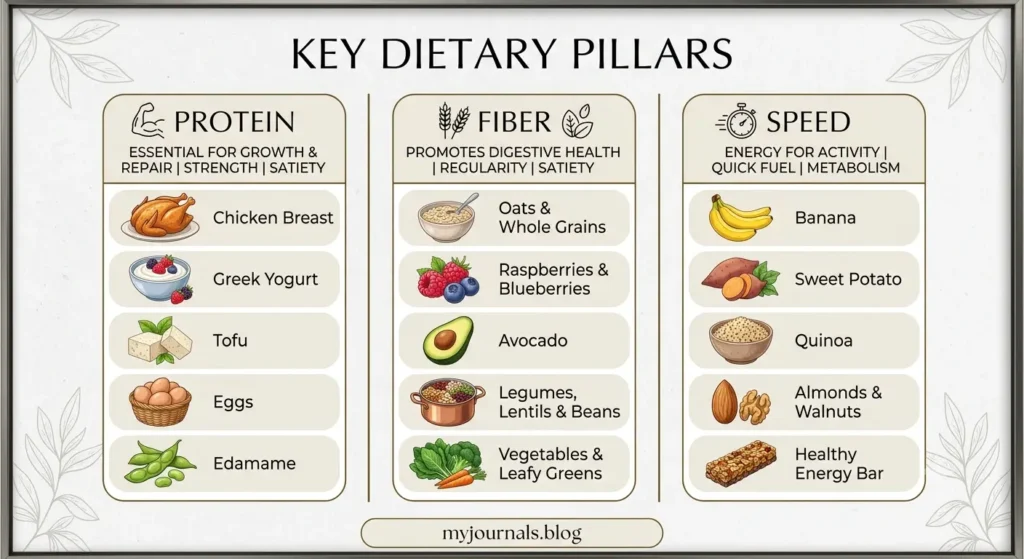
Pillar 1 : Protein (15 to 25g minimum)
Protein extends satiety by three to four hours by suppressing ghrelin (the hunger hormone) and triggering peptide YY (the fullness hormone). Without adequate protein, even a 400-calorie breakfast can leave you hungry by mid-morning.
Best fast protein sources:
- Greek yogurt: 17 to 20g per cup
- Eggs: 6g each, so 2 to 3 eggs = 12 to 18g
- Cottage cheese: 14g per half-cup
- Protein powder: 20 to 25g per scoop
- Almond butter: 7g per 2 tablespoons
Pillar 2 : Fiber (5 to 8g minimum)
Fiber slows down the absorption of glucose, so you won’t experience that 10 AM fog. High-fiber breakfasts are linked to fewer afternoon cravings than low-fiber equivalents, since fiber slows glucose absorption and extends fullness.
Best fast fiber sources:
- Rolled oats: 4g per half-cup dry
- Chia seeds: 5g per tablespoon
- Berries: 3 to 4g per half-cup
- Whole grain bread: 3g per slice
- Banana: 3g per medium fruit
Pillar 3 : Speed (5 minutes or less)
Time is not a cut and dried formula. If it takes more than 5 minutes to eat breakfast, you won’t eat it when life is busy. It is about consistency, rather than perfection, that brings the brain and metabolism benefits mentioned above.
Speed rules:
- No-cook options: 0 to 2 minutes (overnight oats, yogurt bowls, smoothies)
- Light cooking: 3 to 5 minutes (scrambled eggs, oatmeal)
- Batch-prepped: 30 seconds to grab (egg muffins, energy balls made Sunday)
PFS scoring example
25 best breakfast recipes: ranked by speed, protein, and desk-friendliness
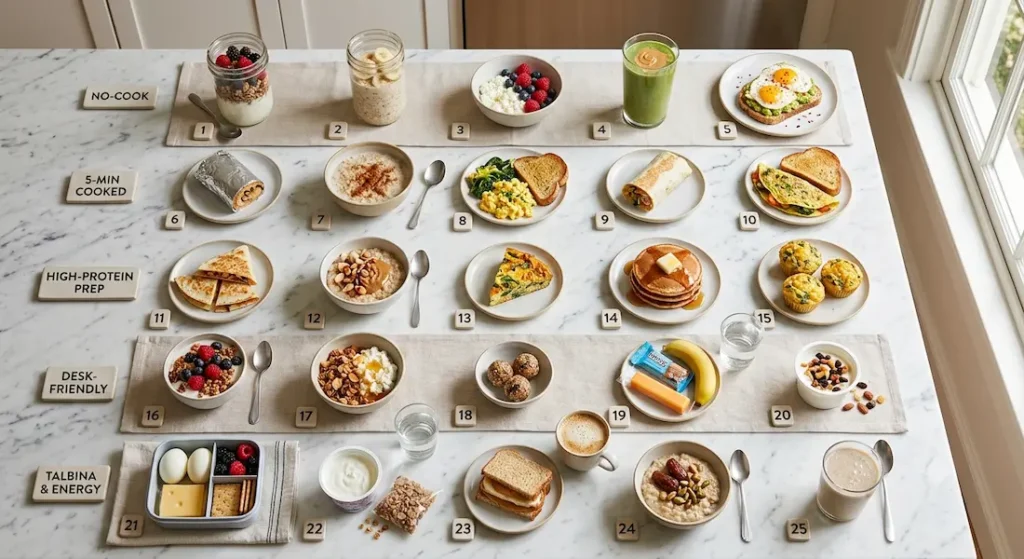
Category 1: no-cook (0 to 2 minutes)
1. Greek yogurt power bowl 1 cup plain Greek yogurt, ½ cup granola, ½ cup mixed berries, 1 tbsp almonds, drizzle of honey. Calories 310 | Protein 20g | Fiber 5g | Time: 2 min.
Why it works: Zero cooking. Maximum nutrition. Layer in a mason jar and eat at your desk.
2. Classic easy overnight oats ½ cup rolled oats, ¾ cup almond milk, 1 tbsp almond butter, ½ frozen banana, pinch of cinnamon, 1 tbsp chia seeds. Calories 340 | Protein 11g | Fiber 8g | Time 0 min (prepped night before).
Why it works: The definition of grab-and-go. Prep five jars Sunday night and your weekday breakfasts are done.
3. Cottage cheese breakfast bowl 1 cup cottage cheese, 1 cup berries, 1 oz granola, drizzle of honey. Calories 310 | Protein 30g | Fiber 6g | Time 2 min.
Why it works: 30g protein in two minutes. Cottage cheese is the most underrated breakfast food in the USA.
4. High-protein smoothie 1 frozen banana, 2 tbsp peanut butter, 1 scoop vanilla protein powder, 1 cup milk, handful of spinach. Calories 380 | Protein 28g | Fiber 5g | Time 2 min.
Why it works: Tastes like a peanut butter milkshake. Drink it in the car.
5. Avocado toast with pre-cooked eggs 2 slices sourdough, ½ avocado mashed, 2 eggs (boiled or fried the night before), sea salt, red pepper flakes. Calories 360 | Protein 14g | Fiber 5g | Time: 2 min (with pre-cooked eggs).
Why it works: Pre-cook eggs Sunday. This becomes a 2-minute assembly job every morning.
6. No-cook peanut butter and berry wrap 1 whole wheat tortilla, 2 tbsp almond butter, ½ cup berries, drizzle of honey. Calories 330 | Protein 9g | Fiber 6g | Time 90 seconds.
Why it works: Roll it, wrap it in foil, eat it on the train. Looks like a treat, performs like a meal.
7. Talbina bowl 3 tbsp Talbina powder, 1 cup warm milk, 1 tbsp honey, pinch of cinnamon. Calories 280 | Protein 12g | Fiber 10g | Time: 3 min.
Why it works: Talbina is roasted barley flour, used across the Middle East for centuries. It is dense in beta-glucans that stabilize blood sugar for hours. Creamy, naturally sweet, and deeply satisfying.
Category 2: 5-minute cooked options
8. Scrambled eggs with spinach and toast 2 eggs, handful of spinach, 2 slices whole grain toast, 1 tbsp butter. Calories 320 | Protein 14g | Fiber 4g | Time: 5 min.
Why it works: The dependable classic. Add any leftover veggie you have.
9. Make-ahead spinach and mushroom egg pinwheels 6 eggs, 1 cup finely chopped spinach, ½ cup diced mushrooms, pinch of black pepper and dried oregano. Calories 95 per pinwheel (2–3 per serving) | Protein 8g | Fiber 1g | Time 30 seconds (microwave from frozen).
Why it works: Rolling the eggs thin instead of baking them thick means these pinwheels reheat faster and more evenly than a dense muffin, with none of the dry, rubbery centers muffins can get from the microwave.
The pinwheel shape also packs in more filling per bite than a folded omelet, giving you a genuinely different texture from anything else in this guide’s egg lineup.
10. Veggie omelet 2 eggs, handful of spinach, diced bell pepper, 2 tbsp cheese, 1 slice toast. Calories 280 | Protein 14g | Fiber 3g | Time: 4 min.
Why it works: Whisk, pour, fold. Done in four minutes with zero technique required.
11.Savory chickpea and cucumber breakfast jar ½ cup mashed chickpeas, ¼ cup diced cucumber, ¼ cup diced tomato, 1 tbsp olive oil, a squeeze of lemon, a pinch of cumin and salt. Calories 260 | Protein 10g | Fiber 8g | Time 3 min.
Why it works: No cooking at all just mash, chop, and layer in a jar the night before, which makes this one of the fastest savory options in the whole guide.
The lemon and olive oil keep it tasting bright and fresh even after sitting overnight, unlike most savory breakfasts that get soggy or heavy by morning.
12. Instant oatmeal with smart toppings 1 cup instant oats, 1.5 cups water, cinnamon, 1 banana, 1 tbsp almond butter, honey. Calories 360 | Protein 10g | Fiber 7g | Time: 5 min.
Why it works: Budget-friendly at about $0.60 per serving. The toppings are what make it a meal rather than a snack.
13. Make-ahead veggie frittata 6 eggs, 1 cup diced peppers and spinach, ¼ cup cheese. Bake for 20 minutes Sunday. Calories 150 per slice | Protein 12g | Fiber 2g | Time 30 seconds (reheat).
Why it works: Bake once on Sunday. Eat four mornings. The most time-efficient cooked breakfast in this guide.
Category 3: high-protein, meal-prep friendly
14. Protein pancakes 1 cup rolled oats blended into flour, 2 eggs, ½ banana, ½ tsp baking powder, vanilla. Calories 280 per 2 pancakes | Protein 14g | Fiber 6g | Time 90 seconds (reheat from frozen).
Why it works: Cook a full batch Sunday (15 minutes), freeze, reheat any morning in 90 seconds. No refined flour, no refined sugar.
15. Batch-prepped egg muffins 8 eggs, ½ cup diced veggies, ¼ cup cheese. Bake in a muffin tin for 20 minutes. Calories 85 per muffin | Protein 7g | Fiber 0.5g | Time 0 min (grab from fridge).
Why it works: Make 12 Sunday, grab three each morning with a banana. One of the most popular quick breakfasts for busy professionals for good reason.
16. High-protein Greek yogurt parfait 1.5 cups plain Greek yogurt, 1 scoop vanilla protein powder, ½ cup granola, ½ cup berries. Calories 320 | Protein 32g | Fiber 4g | Time 3 min.
Why it works: 32g protein. Keeps you full for four-plus hours. Tastes like a dessert.
17. Cottage cheese protein bowl 1 cup low-fat cottage cheese, 1 cup berries, 1 oz granola, drizzle of honey. Calories 280 | Protein 30g | Fiber 5g | Time: 2 min.
Why it works: Protein-to-calorie ratio rivals chicken breast. An underrated option.
18. No-bake protein energy balls ½ cup rolled oats, ¼ cup almond butter, 2 scoops of protein powder, 2 tbsp honey, pinch of sea salt. Calories 110 per ball | Protein 5g | Fiber 1.5g | Time 0 min (grab from fridge).
Why it works: Make 24 in 10 minutes on Sunday. Grab three or four each morning with coffee. Zero cooking.
Category 4: desk-friendly, office-safe options
19. Overnight chia pudding cup with mixed nuts ¼ cup chia seeds, 1 cup milk, 1 tsp honey, a small handful of chopped walnuts and almonds sprinkled on top just before eating. Calories 310 | Protein 14g | Fiber 11g | Time 0 min (prepped the night before).
Why it works: Highest fiber of any desk option in this guide by a wide margin, and it sits sealed in a lidded jar overnight, so there’s zero smell risk nothing to reheat, nothing pungent, completely safe before a client call.
It’s spoon-and-one-hand friendly like the rest of this category, but the thick pudding texture means it won’t spill or slosh the way a thinner smoothie can if your desk gets bumped.
20. Trail mix and yogurt cup 1 individual cup plain Greek yogurt, ¼ cup trail mix (nuts, seeds, dried fruit). Calories 290 | Protein 20g | Fiber 4g | Time 0 min.
Why it works: Portable in a bag. Satisfying crunch. A reliable rotation option when you want texture instead of smoothness.
21. Breakfast bento box 2 hard-boiled eggs, 1 oz cheddar, ½ cup berries, 1 oz almonds, 6 whole grain crackers. Calories 320 | Protein 18g | Fiber 6g | Time 0 min (prepped Sunday).
Why it works: Built-in variety. No utensils needed. Prep five boxes Sunday and eat from them all week.
22. Greek yogurt cup and granola 1 individual plain Greek yogurt cup (17g protein), 1 oz granola, berries. Calories 230 | Protein 18g | Fiber 3g | Time 0 min.
Why it works: The simplest desk option in the list.
23. Peanut butter banana sandwich 2 slices whole grain bread, 2 tbsp natural peanut butter, 1 sliced banana, pinch of cinnamon. Calories 380 | Protein 14g | Fiber 6g | Time: 3 min.
Why it works: Classic for a reason. Travels without refrigeration. Stick it in your bag at 7 AM.
Category 5: Talbina and energy-boosting specialties
24. Talbina with dates and pistachios 3 tbsp Talbina powder, 1 cup milk, 3 pitted dates, 1 tbsp crushed pistachios. Calories 310 | Protein 10g | Fiber 11g | Time 4 min
Why it works: 11g fiber in one bowl. Dates provide natural sugar with a lower glycemic response than refined sweeteners. Middle Eastern tradition, and the barley it’s made from is well-supported by modern research on blood sugar stability
25. Talbina smoothie 2 tbsp Talbina, 1 frozen banana, 1 cup milk, 1 tbsp almond butter, honey. Calories 320 | Protein 12g | Fiber 8g | Time 2 min.
Why it works: Blends into a thick, creamy texture. One of the best energy-boosting breakfast foods for people who dislike “health food” taste.
Healthy breakfast ideas with Greek yogurt: the complete section
Greek yogurt has earned its place as the most versatile ingredient in the quick breakfast toolkit. Here is why the science supports it and how to use it across five distinct recipe styles.
Why Greek yogurt dominates the healthy breakfast ideas space
Greek yogurt contains 15 to 20g of protein per cup, compared to 4 to 5g for regular yogurt. This is not a marginal difference, it is the difference between being hungry at 10 AM and being full until noon.
High-protein breakfasts built around Greek yogurt are consistently linked to lower total daily calorie intake, making it one of the most studied and accessible tools in the weight-management toolkit.
Additional benefits:
- Contains live probiotic cultures that support gut microbiome health
- High in calcium (about 20% of daily value per cup)
- Versatile works sweet, savory, blended, or layered
- Shelf-stable for 7 days the easiest fridge staple to maintain
Nutrition researchers increasingly point to Greek yogurt as one of the few everyday foods that supports satiety, gut health, and blood sugar stability all at once.
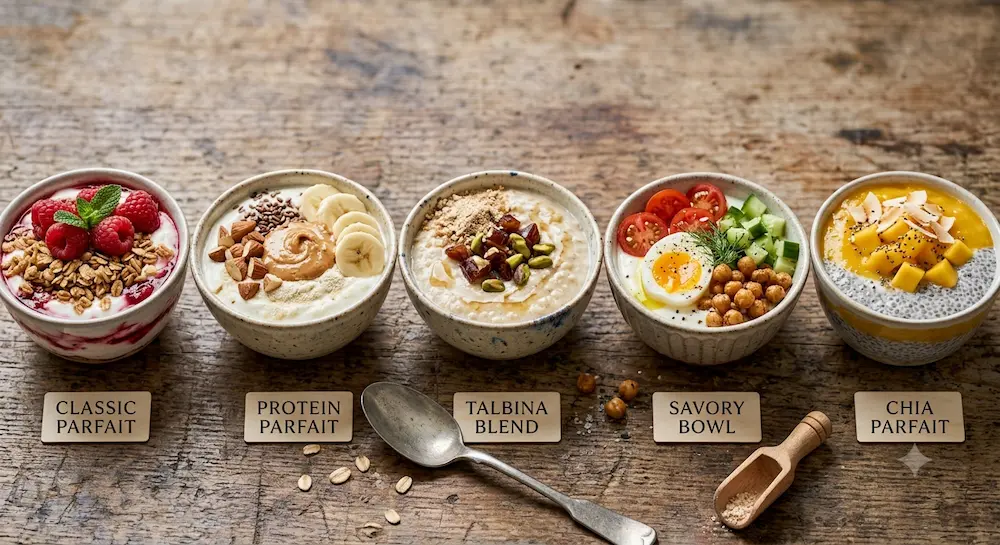
5 best healthy breakfast ideas with Greek yogurt
Style 1: The Classic Parfait 1 cup plain Greek yogurt + ½ cup granola + ½ cup mixed berries + 1 tbsp honey + 1 tbsp almonds. Layer in a glass for visual appeal. Protein 18g | Fiber 6g.
Style 2: The Protein-Stacked Parfait 1 cup Greek yogurt + 1 scoop vanilla protein powder (mixed in first) + ½ cup granola + berries + chia seeds. Mix the protein powder into the yogurt before layering it disappears into the texture. Protein 32g | Fiber 6g. Ideal for post-workout mornings.
Style 3: The Talbina Blend 1 cup Greek yogurt + ¼ cup Talbina powder + berries + honey + granola. Talbina adds 8g of fiber and a nutty, creamy texture that makes this bowl unusually filling. Protein 20g | Fiber 14g. The highest-fiber option in the entire guide.
Style 4: The Savory Bowl 1 cup plain Greek yogurt + sliced cucumber + diced cherry tomatoes + olive oil drizzle + everything bagel seasoning + whole grain crackers. Counterintuitive but surprisingly satisfying. Protein 18g | Fiber 3g. Best for people who find sweet breakfasts too cloying in the morning.
Style 5: The Chia Overnight Parfait 1 cup Greek yogurt + 1 tbsp chia seeds + ½ banana + 1 tbsp almond butter + cinnamon. Prep the night before for a chia pudding texture. Grab and eat cold. Protein 20g | Fiber 8g.
Quick comparison: Greek yogurt vs. other breakfast proteins
Winner for busy professionals: Greek yogurt edges out competitors on the combination of protein density, zero prep time, versatility, and cost. Cottage cheese wins on raw protein count but is less versatile.
Quick and easy breakfast ideas at work: the desk-friendly playbook
Eating at your desk is a skill. Done wrong it damages your professional image, distracts colleagues, and leaves your keyboard smelling like eggs. Done right it saves you $1,200 a year and keeps your morning energy stable.
The three rules of desk breakfast
Rule 1 Zero crumbs, zero regrets. The croissants, loose granola and flaky pastries are desk disasters. Use contained formats sealed yogurt cups, wrapped sandwiches, bento with lids, protein shakes in spill-proof bottles.
Rule 2 Neutral smells only. Hard-boiled eggs in a shared open-plan office will not make you popular. Skip anything pungent eggs reheated in a microwave, pungent cheeses, or anything with onion before client calls or shared morning meetings.
Rule 3 One-hand friendly. If eating breakfast requires two hands and a knife, it belongs at a table. The best desk breakfasts can be managed with a spoon and a free hand while you read your first email.
Best quick breakfast ideas at work by role
The science of energy-boosting breakfast foods (including Talbina)
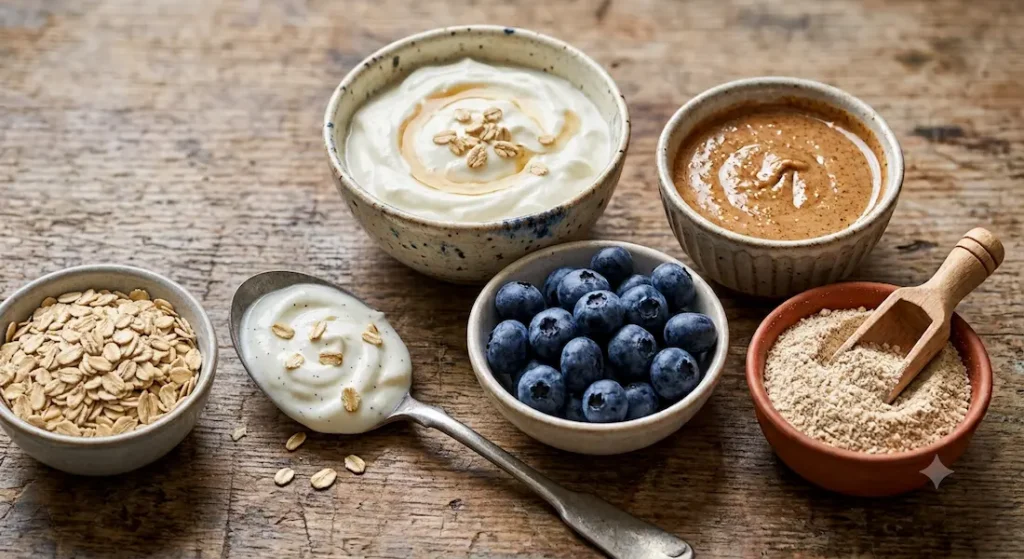
Energy-boosting breakfast foods are not a wellness marketing category. They are a specific nutritional profile: foods that stabilize blood glucose, support neurotransmitter synthesis, and extend cognitive performance across a four-hour window.
The blood sugar mechanism
When you eat refined carbohydrates white bread, sugary cereals, pastries blood glucose spikes within 30 minutes. The pancreas releases insulin to clear the glucose. Glucose drops. Energy crashes. You reach for coffee or a snack. The cycle repeats.
Energy-boosting breakfast foods interrupt this cycle at three points:
- Beta-glucan fiber (oats, Talbina) slows glucose absorption, preventing the sharp spike that leads to a crash later.
- Protein (eggs, yogurt) helps blunt the insulin spike that follows a meal, smoothing out the energy crash.
- Healthy fats (almonds, almond butter, avocado) further slow digestion and extend the satiety window
The neurotransmitter connection
Most people do not realize that breakfast directly affects brain chemistry. Here is the chain:
- Protein → amino acids → dopamine and serotonin precursors
- Dopamine supports motivation, focus, and drive during complex tasks
- Serotonin supports mood stability and emotional regulation throughout the morning
- Skipping protein at breakfast reduces both which is why low-protein mornings often feel foggy and irritable
Top energy-boosting breakfast foods, ranked by mechanism
Spotlight: why Talbina deserves its own entry
Talbina is roasted barley flour, a staple of Middle Eastern and Islamic traditional medicine for over 1,400 years. Modern nutritional science now confirms what practitioners knew intuitively: Talbina’s high beta-glucan content (similar to oats but with a distinct flavor profile) stabilizes blood glucose more effectively than most Western breakfast staples.
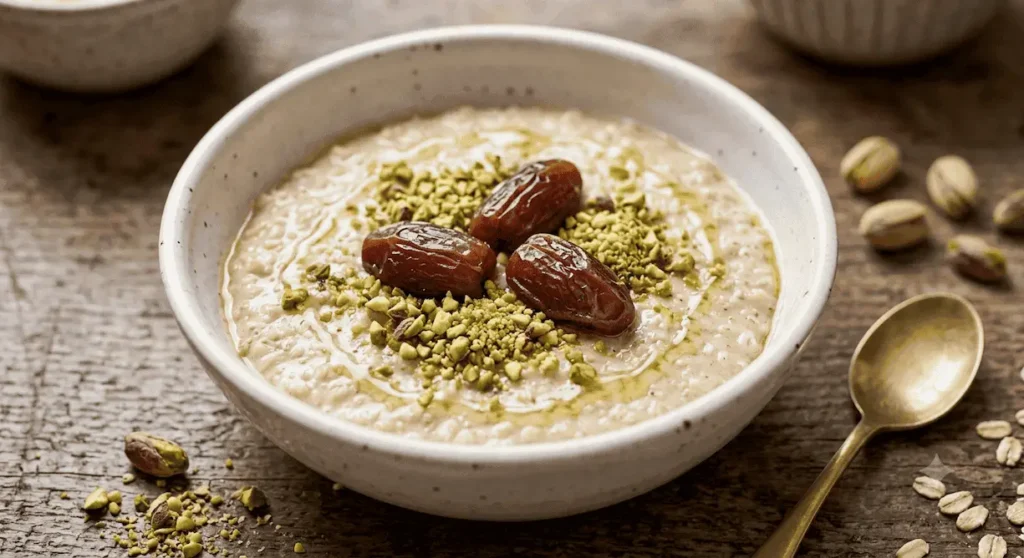
A 100g serving of Talbina provides:
- 10g of dietary fiber almost double that of rolled oats at equivalent volume
- B vitamins including B1, B2, B3, and B6, all involved in energy metabolism
- Tryptophan a direct serotonin precursor linked to improved mood stability
Talbina tastes like a creamy, nutty porridge. It dissolves in warm milk in under three minutes. A 500g bag costs $8 to $12 and lasts three to four weeks. It is one of the most underappreciated energy-boosting breakfast foods on the American market.
Easy overnight oats recipe: master the method
An easy overnight oats recipe is the single highest-impact quick breakfast habit you can build. Zero cooking. Two minutes of prep the night before. Complete nutrition. Four- to five-day shelf life.
The foolproof formula (works every time)
Step 1 :Base. ½ cup rolled oats (not instant, instant loses texture overnight) + ¾ cup liquid (milk, almond milk, or Greek yogurt). Ratio: 1 part oats to 1.5 parts liquid.
Step 2 : Protein (target 15g). Choose one: → 1 tbsp nut butter (7g), or → ½ scoop protein powder (10 to 12g), or → ½ cup Greek yogurt (8 to 10g)
Step 3 : Flavor and fiber (pick two or three). → ½ frozen banana (creaminess + 3g fiber) → ½ cup berries (color + 3g fiber + antioxidants) → 1 tbsp chia seeds (5g fiber + omega-3) → Pinch of cinnamon (blood sugar regulation) → 1 tbsp honey or maple syrup (natural sweetness)
Step 4 Assemble (2 minutes). Pour oats into a wide-mouth mason jar. Add liquid. Stir in protein and flavor additions. Cap tightly. Refrigerate a minimum six hours, up to five days.
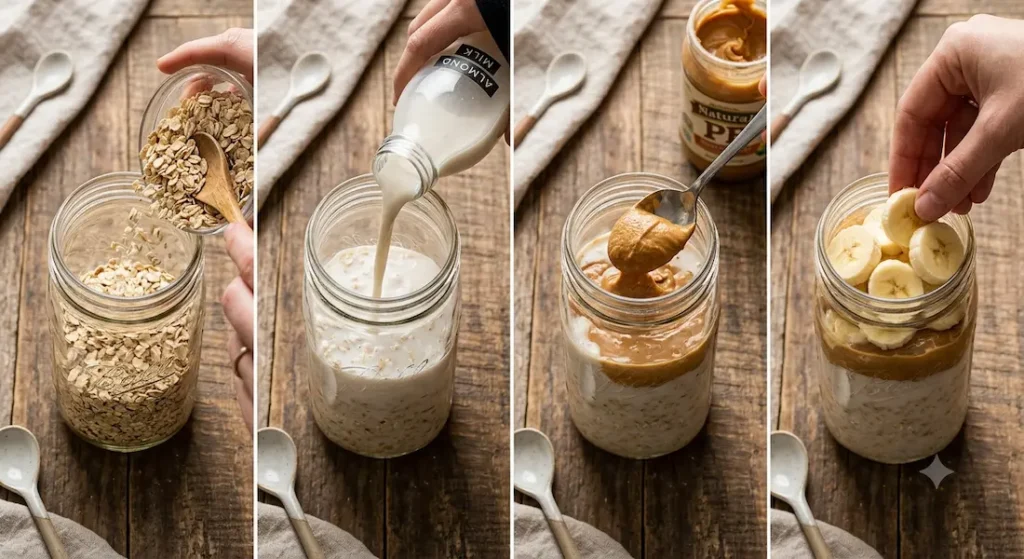
Pro tip: Make all five variations on Sunday using five mason jars. Label them Monday through Friday. Total prep time: 15 minutes. You will never scramble for breakfast on a weekday morning again.
Meal prep for quick breakfasts for busy professionals
People who meal-prep are far more likely to actually eat breakfast consistently than those who decide each morning from scratch.
The 90-minute Sunday prep protocol
Block 1 : Proteins (30 minutes) → Boil 12 eggs (multi-use: egg salad wraps, quick breakfast fuel, bento lunchboxes) → Bake 12 mini crustless quiches (20 minutes passive oven time) → Cook 1 lb chicken breast strips, seasoned with paprika and garlic, for breakfast wraps and bowls (10 minutes active) → Pre-portion six tropical mango Greek yogurt cups into containers
Block 2 : Carbs and fiber (20 minutes) → Portion rolled oats into five mason jars for overnight oats → Chop three cups of mixed berries (store in airtight containers) → Slice five bananas (add a squeeze of lemon juice to prevent browning) → Portion granola into small containers for yogurt bowls
Block 3: Assembly (30 minutes) Build five overnight oats jars (your preferred variation) Assemble five freezer breakfast quesadillas (egg, black beans, cheese), wrap tightly in foil, freeze Build five breakfast bento boxes (2 eggs, cheese, crackers, berries, almonds) Pre-portion energy balls if making (10 minutes, 24 balls)
Block 4 : Label and organize (10 minutes) → Label every container with day of the week → Front-load items that spoil fastest (berries, avocado) for Monday and Tuesday → Stack mason jars in the fridge in order: Monday in front, Friday at the back
How to make a 5-minute breakfast: the step-by-step system
How to make a 5-minute breakfast comes down to a repeatable decision tree, not a specific recipe. Here is the exact system:
Step 1 : Choose your protein source (15 seconds of decision-making) Greek yogurt / cottage cheese → no cook, go to step 3 Eggs → cook, go to step 2 Protein powder → blend, go to step 3
Step 2 : Apply heat (only if cooking eggs, 3 to 4 minutes) Scramble in butter over medium heat (3 minutes) Microwave scramble in a mug: 2 eggs, splash of milk, microwave 90 seconds, stir, 60 more seconds
Step 3 : Add fiber (30 seconds) Grab one: berries, banana, whole grain toast, oats already in jar from Sunday prep
Step 4 : Add healthy fat (15 seconds) Grab one: almond butter, handful of almonds, half an avocado, olive oil drizzle
Step 5 : Combine and eat (60 seconds) Bowl, jar, plate, or hand whichever is fastest
Total active time for the cooked version: 5 minutes. Total active time for the no-cook version: under 2 minutes.
There’s no magic recipe for a fast breakfast it comes down to having the right ingredients ready and a repeatable structure, so you never have to think about what to make on a rushed morning.
Common mistakes destroying your morning energy (and the fixes)
Mistake 1: High protein, zero fiber
Problem: Two scrambled eggs and nothing else. You will be hungry by 10 AM because protein without fiber digests faster than you expect.
Fix: Always pair protein with at least 5g of fiber. One cup of berries, a slice of whole grain toast, or a tablespoon of chia seeds does the job.
Before vs. after: Before: 2 eggs (12g protein, 0g fiber) → hungry by 10 AM After: 2 eggs + 1 cup berries + 1 slice whole grain toast (12g protein, 7g fiber) → full until noon
Mistake 2 : Buying “healthy” yogurt with 20g+ added sugar
Problem: The yogurt aisle is full of fat-free, fruit-flavored options that look healthy and taste like candy. Most contain 18 to 25g of added sugar equivalent to five teaspoons.
Fix: Always buy plain Greek yogurt with 0g added sugar. Sweeten it yourself with a teaspoon of honey (4g sugar, natural, with trace antioxidants) or fresh berries.
Label comparison: Flavored low-fat yogurt: 17g protein, 22g added sugar not a win Plain Greek yogurt + 1 tsp honey + berries: 20g protein, 8g total sugar strong choice
Mistake 3 : Eating breakfast randomly vs. consistently
Problem: The benefits of eating breakfast compound with consistency. Eating breakfast twice a week is not equivalent to eating it daily. Your cortisol patterns, ghrelin rhythms, and glucose regulation all respond to habit, not occasional behavior.
Fix: Treat breakfast like a scheduled appointment. Sunday meal prep makes this automatic you cannot skip something that is already prepared and labeled for Tuesday.
Mistake 4: eating too little and crashing by 11 AM
Problem: A 150-calorie granola bar is not a breakfast. It is a snack. Eating too few calories in the morning triggers compensatory hunger that hits harder and leads to worse food choices later.
Fix: Target 300 to 400 calories with the 40/30/30 split from the PFS Matrix (40% carbs, 30% protein, 30% fat).
Mistake 5 : Skipping breakfast to “save time”
Problem: The time you save by skipping breakfast is small compared to the focus you lose across the whole morning
Fix: Meal-prep one batch of items on Sunday. From Monday onward, breakfast takes 30 to 90 seconds.
What this can look like in practice
The situation
Picture a software engineer in their mid-30s working 70-plus hour weeks, skipping breakfast four or five days out of seven. The pattern is a familiar one: black coffee at 7 AM, nothing until a 2 PM lunch that quietly balloons past 2,000+ calories, then an afternoon energy collapse between 2 and 4 PM that wipes out the best deep-work hours of the day.
Add it up over a month: roughly $150–160 spent on coffee-shop breakfasts and afternoon snacking, slow weight gain from uncontrolled snacking, and brain fog setting in from mid-morning onward every day.
The intervention
Apply the Protein Fiber Speed framework plus the 90-minute Sunday meal-prep protocol for four weeks.
Week 1 Sunday prep (roughly 90 minutes):
- 5 overnight oats jars (peanut butter banana)
- 5 freezer breakfast quesadillas (egg, black beans, cheese, peppers), frozen individually
- 12 boiled eggs (backup option, bento boxes)
- 4 pre-portioned Greek yogurt parfaits
- 1 batch of 18 no-bake protein energy balls
Estimated weekly grocery cost: ~$20–25, versus ~$40/week in prior ad hoc breakfast spending.
What typically changes by week four
FAQ: People Also Ask
Under two minutes is realistic if you go no-cook: overnight oats, Greek yogurt bowls, protein shakes, or pre-made egg muffins. Batch-prep them on Sunday and mornings become a 30-second grab-and-go.
Stick to three components protein, fiber, fat and skip heat unless eggs are involved. That keeps no-cook versions under two minutes and cooked versions under five.
Overnight oats, Greek yogurt parfaits, cottage cheese bowls, chia pudding, protein shakes, and peanut butter fruit wraps cover most cravings. Each assembles in under three minutes with at least 12g of protein.
A classic parfait yogurt, granola, berries, honey delivers 18g of protein, and swapping in protein powder pushes that to 32g. Savory versions (yogurt, cucumber, tomato, olive oil, bagel seasoning) and overnight chia parfaits are worth rotating in too.
Beta-glucan fiber in rolled oats keeps blood glucose stable for 4+ hours, while choline in eggs supports focus and protein in Greek yogurt suppresses hunger. Blueberries, almonds, and Talbina round things out with antioxidant and mood benefits.
People who eat breakfast daily tend to report better focus and fewer afternoon cravings than those who skip it, likely tied to steadier blood sugar and satiety hormone levels through the morning.
Three options consistently deliver: overnight oats (zero active minutes), a reheated breakfast burrito (45 seconds), and a Greek yogurt parfait (90 seconds). All three hit 15g+ protein and 5g+ fiber for under $2.
Roasted barley flour is the base of Talbina, delivering 10g of fiber and a spread of B vitamins per 3-tablespoon serving. For anyone wanting more fiber than oats with a creamier texture, it’s worth the $8–$12 per 500g bag.
Yes high-protein breakfasts are linked to lower total daily calorie intake and less mid-morning snacking. The mechanism is hormonal: protein and fiber suppress ghrelin and raise satiety hormones, curbing appetite for a few hours.
Key takeaways: everything in one place
- 25 recipes across five categories: no-cook, 5-minute cooked, high-protein, desk-friendly, and Talbina specialties.
- The PFS Matrix (Protein Fiber Speed) is the framework: 15 to 25g protein + 5 to 8g fiber + under 5 minutes = a breakfast that works.
- Healthy breakfast ideas with Greek yogurt deliver 17 to 32g protein with zero cooking the most versatile single ingredient in this guide.
- Benefits of eating breakfast daily include better focus, fewer afternoon cravings, lower total calorie intake, and $1,200+ in annual savings.
- Energy-boosting breakfast foods oats, eggs, Greek yogurt, berries, almonds, Talbina work by stabilizing blood glucose and supporting neurotransmitter production.
- Easy overnight oats recipe = 2 minutes of Sunday prep, zero cooking, 5-day shelf life, and endlessly customizable
- 90-minute Sunday protocol eliminates all weekday decisions and reduces daily breakfast time to 30 to 90 seconds.
- Talbina is the most underutilized energy-boosting breakfast food on this list 10g fiber per serving, backed by centuries of traditional use and its beta-glucan fiber content.
Conclusion
You now have everything you need: 25 recipes, a scoring framework, a Sunday protocol, and the science behind why breakfast matters more than most professionals realize.
The fastest path forward: pick one easy overnight oats recipe from this guide, assemble it tonight, and eat it tomorrow morning. Notice your energy at 11 AM. That single data point will tell you whether this is worth continuing.
Then block 90 minutes next Sunday for the full meal-prep protocol. Make five burritos, five oats jars, and a tray of egg muffins. Your mornings and your afternoons will not be the same.
Your next steps (do at least one today)
- Pick three recipes from this guide that genuinely appeal to you and screenshot them.
- Add to your shopping list: eggs, rolled oats, plain Greek yogurt, berries, almond butter, protein powder.
- Set a Sunday calendar block for 90 minutes labeled “Breakfast Prep”.
- Try one recipe tomorrow and check your energy at 11 AM and 3 PM
For the most up-to-date information on quick and easy breakfast ideas, bookmark this page and return whenever your breakfast rotation needs refreshing.

Leave a Reply